Contact us

Faculty of Arts and Social Sciences
Kingston University
Penrhyn Road
Kingston upon Thames
Surrey KT1 2EE

Tel: +44 (0)20 8417 9000

Conferences and workshops

Peripheral Visions: Suburbs, Representation and Innovation - 17/18 June 2011

Recent work in the burgeoning interdisciplinary field of suburban studies has focused on how suburbs have become increasingly diverse and dynamic places. Arguably, though, perceptions of suburban life, whether in executive commuter belts, banlieues or shanty towns, continue to be dominated by a relatively narrow range of representations. Yet, as suburbs have emerged, developed and diversified, new forms of creative production - across film, photography, literature, music and digital media - have arisen from and in response to them. This two-day conference will investigate what it is about these seemingly inauspicious environments and lifestyles that has rendered them so inspirational. It seeks to illuminate the aesthetic shifts and formal innovations that have been involved in their representation over the last century, across all media and genres, and within and across different cultures and territories. By focusing on such innovations, Peripheral Visions will interrogate developments to concepts that are central to twentieth and twenty-first century life, including property, autonomy, consumption and citizenship.

Confirmed keynote speakers:

  • Professor Rob Shields (University of Alberta)
  • Professor Carrie Tarr (Kingston University)
  • Dr Jo Gill (University of Exeter)

We welcome proposals for panels and papers which explore topics including, but not limited to:

  • Defining suburban aesthetics and poetics
  • Suburbs and genre
  • The suburb as fictional world
  • New technologies and auto-documentary / subcultural production
  • Pioneer suburbs and their representation
  • Poverty on the periphery / the suburbs in economic crisis
  • Suburban pasts, suburban futures
  • Representing transnational suburbs

We also welcome contributions which cross critical/creative boundaries.

Registration is now open. To register online and for delegate information including details of local accommodation, visit here.

'Superbia - The Case for Suburbia' - September 2006

Organised by the Centre for Suburban Studies in association with audacity and sponsored by the Modern Masonry Alliance.

This professional day school challenged current orthodoxy on urban regeneration by presenting an alternative suburban vision of the future to an audience of policy makers, planners and architects.

The day opened with Nick Hubble and Rebecca Preston welcoming the speakers and audience to Kingston University and introducing the unique socio-cultural focus of the Centre for Suburban Studies. Rebecca spoke on the long history of suburbs and the ways in which they have always been derided by the cultural elite as boring or disreputable or, frequently, both at the same time.

Paul Oliver with his book Dunroamin and 25th birthday cake

Nick discussed the Centre's successful Suburban Futures Programme and forthcoming report of the same name. Explaining that the mass movement towards suburban living since the second half of the 19th century represents a historical shift of comparable magnitude to the earlier transition from agricultural to industrial society, he described how current government policy was completely out of tune with this trend and could result only in social breakdown. Instead, he presented an alternative vision of the future in which planned suburban expansion across the south of England created a decentralised society flourishing in a human landscape. Having set the framework for the debate, the Centre staff sat back in order to listen to the professionals outline the technical aspects of the situation.

In a strong keynote address, Jon Rouse, Chief Executive of the Housing Corporation, argued that we simply cannot go back to housing families in tower blocks but must build houses with gardens. He gave seven reasons why suburbs remain the answer to our problems:

  1. Suburbia is the only means of filling the doughnut - referring to the 'shatterzone' that separates the urban cores of our cities from the outlying prosperous commuter belts.
  2. Only Suburban Designs can give us Mixed Communities.
  3. Only Suburbs can reconcile national and local planning objectives.
  4. Suburbs are what people with no choice, choose.
  5. Suburbs can protect the rural domain.
  6. Suburbs can be very sustainable.
  7. Good suburban design is very flexible and adaptable.

Following Jon's presentation, Alan Hudson of the Oxford University Department for Continuing Education added valuable political context with his account of how Middle England has become a suburban community. The argument over suburbia has become particularly heated, he explained, because the term no longer simply refers to a form of housing but has become a cipher for the relationship between the people and government. The desire for suburban living marks an attempt to get away from both the uneasy alliance between bureaucracy and the market which dominates society today and the endless managerial/technical interventions of government which have come to replace any genuine political process.

The panel answering questions in the morning discussion

In the afternoon, the audience listened to speakers debating the question of changing the planning laws and increasing greenfield housing.

Rynd Smith, Head of Policy and Practices at the Royal Town and Planning Institute, warned that total deregulation might lead to 'the threat of discount exurbia' and called for the expansion of 'permitted use and development rights' to allow local development within a broad strategic plan. James O'Shaughnessy, Head of Research at Policy Exchange, echoed the need for devolving development to the local level and explained Policy Exchange's recommendations for local government finance reform and a social cost tariff allowing communities to share in the benefits of development. Michael Owens, Head of Service at the Regeneration Division of the London Borough of Merton, discussed how a local focus could restore social and political agency.

The panel answering questions in the afternoon discussion

Shelagh Grant, Chief Executive at the Housing Forum, agreed on a need to liberalise the planning laws in order to allow new development and alleviate the threat of overdeveloping existing communities. James Heartfield, a director of audacity and author of Let's Build: Why We Need Five Million New Homes in the Next Ten Years, made an impassioned plea for overturning the Town and Country Planning Act and allowing development wherever land can be bought.

While there was a lively debate concerning how far deregulation should go, a clear consensus emerged on the need for liberalisation of the current planning laws in order to allow the much-needed building of suburban-type housing on greenbelt and greenfield sites.

The event was followed by a launch party in honour of James Heartfield's Let's Build and the Centre for Suburban Studies' forthcoming report, Suburban Futures by Nick Hubble.

The day as a whole marked a key stage in the emergence of a new agenda favouring the mass building of suburban houses as the only means of alleviating the housing shortage and making homes with gardens available to ordinary people again. Following the event and the extensive media coverage it has generated, it can be expected that this debate will gather pace in the think tanks and policy and planning spheres.

As part of a state university, the Centre for Suburban Studies is committed to keeping these arguments in the public sphere. While our rigorous academic research into suburban cultural identity continues, we will follow up our completed Suburban Futures Programme with a new programme, Researching Suburban Lives, investigating processes of participatory qualitative social research that don't merely take suburban people as their passive subjects but seek to restore agency to individuals and reconnect them to new forms of the political process appropriate to the 21st century.

Annual Suburban Studies Lecture by Prof. Paul Oliver - June 2006

On Wednesday 7 June 2006, Professor Paul Oliver came to Kingston University to deliver the Annual Suburban Studies Lecture, which also featured as part of this year's Suburban Futures Programme. Professor Oliver was the principle author of Dunroamin, the seminal study of Britain's interwar suburbia first published in 1981. To mark this 25th anniversary, the Centre for Suburban Studies presented Professor Oliver with a specially-made cake in the shape of a pair of semi-detached houses.

Paul Oliver with his book Dunroamin and 25th birthday cake
Close-up of Paul Oliver's 25th birthday cake

Dunroamin was a defence of the interwar suburbs against the concerted disdain of the planning and architectural establishments in the postwar years. Oliver and his co-authors, Ian Davis and Ian Bentley, argued that the suburbs were not merely spec-built sprawl but the reflection of a coherent system of values revolving around home, family, stability and individualism. While these values have been attacked as a hindrance to the development of community spirit, the suburbs proved much more resilient than alternative housing forms in resisting the social breakdown of the 1970s.

According to Oliver, the suburbs' essential ability to maintain a stable environment in which individuals and families could adapt to a rapidly changing outside world is no accident but the consequence of their provision of a sheltered space for imagination. In particular, the quality of suburban 'fancy' - a combination of fantasising about material objects and the fantastic qualities within them - was and is that it allows individual and shared values to be imposed on the sterile and mass-produced goods of modern society.

In his lecture, Professor Oliver held his audience enthralled with his latest arguments on the value of the suburban lifestyle and the opportunities for self-expression that it enables. His talk ended on a sad note, however, when he lamented the apparent inability of planners and architects to learn from history as the government appear set to repeat the social-engineering policies of the 1960s and promote urban densification and high-rise schemes in place of the suburban developments which the overwhelming majority of the population prefer.

'Suburban Future: Participatory Lifestyles' - March 2006

Photograph of Giles Lane, Melissa Mean and Nick Hubble

This event, which ran as part of Kingston Council's Think in Kingston series, was also the launch of the Centre for Suburban Studies' Suburban Futures Programme. Nick Hubble of the Centre for Suburban Studies, Melissa Mean, Senior Researcher at Demos, and Giles Lanes of Proboscis, the artist-led organisation specialising in social interaction, spoke about new and developing forms of lifestyle and consciousness in the suburbs.

Giles Lane described Proboscis' technique of 'public authoring', a process of mapping and sharing local knowledge and experience, as a radical challenge to information systems focused on the push of content to consumers. He went on to explain how Proboscis' work in creating and demonstrating an alternative vision for the use of pervasive technologies has sought to inspire business, industry, government and civil society by challenging the established models for services.

Melissa Mean drew on her experience of co-writing the Demos report People Make Places to address the specific concerns of the suburbs. She addressed issues of creeping privatisation and social fragmentation by arguing that the best 'public' spaces are created by people themselves irrespectively of whether the places are publicly or privately owned. After discussing how Demos had set forward the forms of governance, design principles and everyday uses that can help boost people's participation in public space and the wider public life around them, she presented some more light-hearted ideas specifically geared towards suburbs such as encouraging 'Ramsay Street-style communal barbecues'.

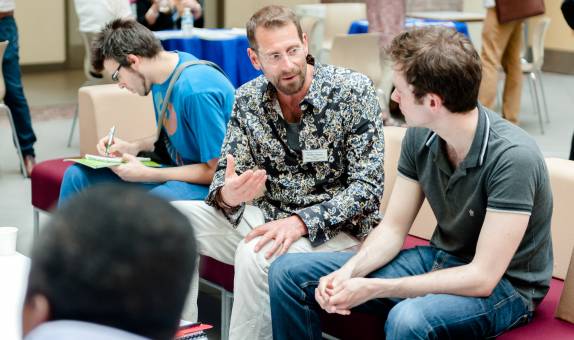
Photograph of Melissa Mean and Nick Hubble in discussion

Nick Hubble discussed how suburbs have moved beyond the garden gnome stage by arguing that whereas suburbs were once negatively viewed by architectural critics as an escape from the challenge of the city, they can now be viewed positively as an attempt to escape from the restrictive normalising forces of hierarchical and traditional models of society. He went on to suggest that the perceived weaknesses of suburbia - everyday repetition, privacy, not knowing all your neighbours - are in fact strengths giving their inhabitants the space to gain agency within their everyday lives and achieve self-actualisation in modern Britain.

The presentations were followed by a panel discussion and question-and-answer session.

This event and the Demos report on suburbia triggered coverage and a lively public debate on BBC online.

'Literary London' - July 2005

The 4th Annual Literary London conference was jointly hosted by the Department of English and the Centre for Suburban Studies at Kingston University, London. Speakers included Professor Stanley Wells, Professor Elizabeth Wilson, and Professor Julian Wolfreys.

'Successful Suburbs, Successful Cities' - March 2005

Event jointly convened with the London Borough of Barnet and The Guardian newspaper.

'Suburban Regeneration' - February 2005

Event jointly convened with the London Women and Planning Forum as part of the ESRC seminar series 'Women and Planning in Contemporary London'.

The 'Good Life' conference - September 2004

The 'Good Life' conference took place at Kingston University on Friday 24 September 2004. The conference title was inspired by the classic television situation comedy The Good Life. Set in Surbiton and featuring two couples with very different lifestyles, it encapsulated the spirit of suburban life in the Britain of the late 1970s.

But the lifestyle choices it reflected remain just as relevant today as when the series was first broadcast between 1975 and 1978. The Good Life raised questions of sustainable development and self-sufficiency. It highlighted the issues of suburban identity in its protean division between the rural and the urban way of life, depicting as it did different patterns of suburban life and aspects of the material culture of the suburbs.

Academics from around the country joined local government and town planning experts to explore issues including the history of suburbia; politics and health in suburbia; perceptions of suburbia; and suburban culture.

The Launch - 23 April 2004

The Centre for Suburban Studies was launched on Friday 23 April 2004 to great academic and media interest. Dr Vesna Goldsworthy, Director of the Centre, gave over 50 television and radio interviews in the week of the launch and continues to comment on suburb-related issues. Some 40 articles reported the opening of the Centre in newspapers as varied as the Statesman of Calcutta, the Scotsman and the Australian.

Britain's broadsheet newspapers devoted entire pages to suburban studies and the launch of the Centre. Leaders, comments and op-ed pieces in The Guardian, The Independent and The Times applauded its timeliness, and The Sunday Telegraph even published a specially commissioned poem. Dozens of emails and letters of support from members of the public were received, as well as a number of approaches from institutions and scholars seeking to collaborate with the Centre.

The official launch at Kingston University's Town House consisted of a panel debate on suburbia in front of an invited audience, including researchers, town planners, transport experts and writers on suburbia from a range of different institutions. The panellists included:

  • Professor Gail Cunningham, Dean of the Faculty of Arts and Social Sciences at Kingston, an expert on suburban fictions
  • Professor Elizabeth Wilson from London Metropolitan University, author of books The Sphinx and the City and The Contradictions of Culture, which offer a fascinating framework for a study of the city and its edges
  • Dr Mark Clapson from the University of Westminster, social historian and author of a number of influential books on suburbia, including an extremely well received study of Milton Keynes
  • Dr Rebecca Preston from the Geffrye Museum, an expert on gardens, parks and suburban development
  • Trevor Keeble, Senior Lecturer in Design History at Kingston University, a specialist on identity and Victorian interior design.

Discussions ranged from an examination of the literary views of suburbs to comparisons between anthropological, geographical and sociological definitions of suburbia. Panellists and members of the audience highlighted important issues of private and social space in suburbia, and examined the role of architects, planners and transport specialists in the creation of successful suburbs. Finally, the debate identified important areas of potential research and a consultancy role for the Centre: acting as advisors to a sorely needed suburban white paper.

As The Guardian's leader of the day before had suggested:

'Residential districts that now accommodate over half the country's population are ripe for study by town planners, sociologists and architects - as they have long been in America. The Kingston Centre's remit is wider still. It also intends to look at the suburb in film, fiction and history. The roots of British prejudice against suburbia - a love that dare not speak its name, says the Centre - will repay exploration.'

The Guardian, Thursday April 22, 2004

Related articles

Swing: Aunt Queenie and Jeanette. Real photo postcard, unknown location, c. 1940